Monday, November 28, 2011

Stuffed Bellies and Birds: Thanksgiving at Prakanong Rock

Happy Thanksgiving from Thailand!!!
On Thursday 24 November, I hosted my first Thanksgiving dinner… in Thailand.  Thanksgiving is perhaps my favorite holiday, because it is a time when you can enjoy family, eat a hearty meal, and remember all that you have to be thankful for.  I decided that rather than celebrate alone and by myself (which isn’t really the purpose of the holiday at all!) I would invite my Thai classmates and new family over.  We crammed 22 students into my tiny apartment in Prakanong and celebrated life, family and friends over a delicious meal.  It was the first time I had a turkey without grandma’s supervision and I quickly learned that for six of the 22 of us – it was their first time ever eating turkey! 
Delicious dinner - from all over the world :)

It was a very international Thanksgiving, where each person came with a traditional dish from home.  We had turkey and stuffing, with side dishes of Massaman curry, Indonesian noodles and Japanese sushi.  We had Thai fruits and a Colombian sweet dessert, and beer from Lao.  

 
When I began spreading word of my party a few weeks before, I realized that no one knew what Thanksgiving was – because of course, it is only celebrated in the United States.  I had made a few jokes and references to history in my invitation that no one understood because no one knew what pilgrims and Native Americans were, and only two people from my class had seen Pocahontas so I couldn’t even rely on Disney’s horrible portrayal of history to help me.  After more people began to look up ‘pilgrims,’ ‘Plymouth Rock’ and ‘Native American,’ the decision was made that Thanksgiving would be a “costume party” – of course, with only two options being – Native American or pilgrim.  I bought face paint (you have NO idea how hard it is to find that here in Thailand) and feathers, and we had way too much fun dressing up.
My FIRST turkey!
Because no one else had to learn “American history,” I found myself having to explain it - I had never had to explain Jamestown, pilgrims, John Smith or Thanksgiving, because everyone around me also had to endure the painfully boring history class on U.S. colonization and settlement.  It was kind of fun to explain it to people…although I also realized how little I could accurately remember from my middle school history classes!

As we were all sitting there, sharing stories, and having an amazing time, I had a moment where I had to pinch myself and make sure it all was real.


The two Americans - celebrating Thanksgiving in a not-so-traditional way!
In the past year, I went from a desk job in cold New York City to an incredibly new, different and beautiful life here in Thailand.  I am learning so much culturally and academically each and every day I often wonder if my brain will explode!  I am surrounded by incredibly intelligent and interesting individuals that challenge my learning in new ways each and every day.  Today, I am thankful for my friends and family at home – who have supported me on this amazing adventure from the beginning.  I am also grateful for my new friends and family here in Thailand and cannot wait for the next year of adventures together.  And I am most thankful to Rotary International and Foster City – who, without their help, love and support, I never would find myself sitting on the floor of my apartment eating sushi and curry for Thanksgiving dinner 8,000 miles from home.

ASEAN Post-Summit Briefing

On Monday November 21st at 8:30am, I found myself walking into the World Bank in Bangkok.  I wasn’t entirely sure what I was doing there – I knew that along with seven other students from my program, I was chosen to attend a Post-19th ASEAN (Association of Southeast Asian Nations) Summit Briefing.  I was told the conference would review the key highlights and outcomes of the ASEAN Summit which took place from 17-19 November 2011 in Bali, Indonesia.

Chula MAIDS students at the World Bank for the ASEAN Post-Summit Briefing!
I walked into the room, expecting a lot of other students to be fidgeting in their business suits and heels.  To my surprise, I found real suits, real professionals, and really really important people.  As we went around the room, it was not only clear that we were the youngest and least experienced people in the room, but it was also evident that we were the only students or academic representation!  In the room, (besides us students), there were embassy officials, World Bank managers, development workers, international trade businessmen and NGO executives.

The facilitator of our Bangkok group, introduced himself as a manager within the World Bank, and explained how the next three hours would unfold.  He explained that this would be a live, interactive video connection between eight designated ASEAN Member States (Cambodia, Indonesia, Lao PDR, Malaysia, the Philippines, Singapore, Thailand, and Vietnam) and four ASEAN Dialogue Partners (Australia, China, Japan, and Republic of Korea).  He said we had a few minutes to review the packets of materials from the Conference, and each person was expected to raise a few follow-up questions.  We would then brainstorm together what one question we wanted to ask as a group.
 
I     I immediately felt like I had just walked into a pop quiz that I was completely unprepared for.  I suddenly couldn’t remember what ASEAN even stood for, and I frantically tried to find answers by sifting through all the reports they had provided us with.  I knew what questions I wanted to ask, but was NOT about to raise my hand given the level of the audience in the room.  I secretly wanted to ask about two current issues:

      #1:  What ASEAN thought of the inclusion of Russia and the United States in the Summit and how ASEAN will maintain a strong voice with the dominant U.S. now involved.

#2:  Myanmar and the current refugee crisis

I didn’t dare ask the first one because I was overly-sensitive to the fact that I was an American sitting in the middle of a South East ASIAN Briefing and didn’t want someone to think that I was projecting my ideas of the US on this Asian conference.  As for the second question, I honestly didn’t know enough about the current issue – but had attended a briefing by U.S. Assistant Secretary of State for East Asian and Pacific Affairs Kurt Campbell, and was utterly disappointed and embarrassed at how he averted the overwhelming amount of questions in regards to the issue, and hoped that ASEAN could better explain the situation.
The first man that raised his hand was a Japanese businessman.  He said, “I am curious to see how ASEAN did in the recent Summit and would question whether they will be able to remain dominant with the US in the room…”  I laughed a little to myself the minute he said this – after I had been so harsh on myself in not asking that question.  Other suggestions included US relations with China (which was a little off because neither party is in ASEAN but nevertheless, it is of great concern and impact to this region), the recent floods in Thailand, Cambodia and Viet Nam, trade between ASEAN and non-ASEAN states, and the current situation with Myanmar and refugees. 

Our Thailand group decided on the first question – with regards to how ASEAN will remain strong with the entrance of the big bullying U.S. and within seconds, the meeting started.  Soon, a familiar face was on the screen – he was an incredibly smooth speaker, with perfect English, and beautiful expression and tone in his voice.  I swore he looked familiar but his name didn’t ring a bell.  It wasn’t until I went home and googled him that I remembered where I had seen him before.

Dr. Surin Pitsuwan, Secretary-General of ASEAN
Dr. Surin Pitsuwan, the current Secretary-General of ASEAN, is from Thailand and is most famously known as the former Minister of Foreign Affairs (from 1997-2001).  He has both his Master’s and Ph.D. from Harvard and his CV is pretty extraordinary.  But it took me some serious scrolling and sifting to find out where I had actually seen him before…and then I found it and remembered perfectly.

Dr. Surin Pitsuwan was considered a serious candidate to succeed Kofi Annan as the United Nations Secretary-General.  But, due to Thailand's internal politics, the Thai government, led by Thaksin Shinawatra at the time, decided to endorse Surakiat Sathianthai instead. Sathianthai subsequently lost to Ban-Ki Moon. Many academics and political analysts viewed that had Thailand supported Pitsuwan's candidacy instead of Sathianthai's, the country could have had its citizen leading the United Nations.

I immediately noticed a huge difference between Dr. Pitsuwan and Dr. Campbell.  It was no secret that I hadn’t been particularly fond of Dr. Campbell’s address – mainly because he seemed incredibly unprofessional in everything from body language, respect of customs, and language, but also because he could not answer the most basic of questions.  As a politician or figurehead, you must answer questions in a diplomatic and persuasive way…Dr. Campbell often detoured questions, was extremely vague, or worse – flat our refused to answer them.  Disappointment does not even begin to describe my appalled reaction to Dr. Campbell’s lecture. 

Dr. Pitsuwan on the other hand, was beautiful to both listen to and watch.  He kept listeners enthralled for three hours as he walked them through every angle of the ASEAN Summit imaginable.  He knew statistics and had facts memorized and ready to deliver at the palm of his hand.  He never stuttered, fidgeted or looked uncomfortable.  He stood, at a podium for three hours – answering 12 countries questions – ranging from issues on improvements to education, the ASEAN community of 2015, free trade agreements, China’s role in future and how it impacts ASEAN, refugees in Burma, Climate Change, security, natural disasters, a bid to North Korea for ASEAN, maternal health and more.  Not only did he answer each and every single one, but he had specific facts, plans and measures taken, to back his words.
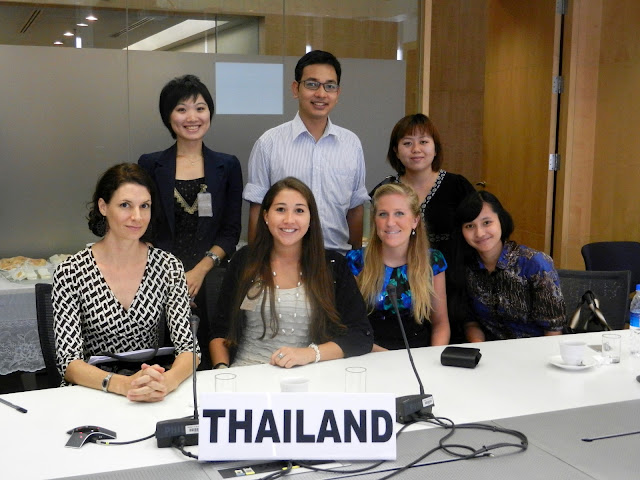
Chulalongkorn MAIDS students at the World Bank for a Post ASEAN Briefing
If there has ever been a definition for “professional diplomat” or “professional politician” I am fairly certain that you will see Dr. Pitsuwan’s name in that dictionary.  He was remarkable.  What I perhaps appreciated most however is that he was not afraid to flirt with fire.  Most politicians and especially diplomats at the United Nations are hesitant to say anything controversial or anti-main stream.  Yet Dr. Pitsuwan was much more honest when responding to the genuine concerns of countries, empathizing with their situations, and admitting fault in ASEAN when necessary.  When questioned on whether ASEAN would consider offering a bid to North Korea Dr. Pitsuwan said, “I invited them to this Conference, I was very disappointed that they did not come, and if ASEAN were going to offer anyone a bid, it would be to a country that is non-threatening, participatory and helpful in wanting to improve ways of life.”  Wow.  He just drew that line…crystal clear!

Overall, the ASEAN Post-Summit was an amazing event.  I met and interacted with representatives from business organizations, diplomatic affairs, policy makers, law makers, civil society, media, military, and the private sector.  As each country went around the room introducing the various peoples in the room – other countries included many Ambassadors and even the Prince of Cambodia!  It was incredible to listen to each country describe the participants present, and watch our faces as we realized we were not only the only students in the Thailand branch with students, but we were the only students represented in the entire Post-Summit briefing!

Convention on the Rights of the Child: What the Hell is Wrong with you America?!


While class has been a whirlpool of different cultures, viewpoints, and reasoning, as the American student – I am rather exhausted, frustrated and sick of my country.  While there are many wonderful parts of America (I think?  Although at the moment I am having a hard time remembering!), in the world of international development, equality and law – we aren’t the role models we pretend to be.
In our Human Rights course today, we learned about the Convention on the Rights of the Child – a treaty that 192 of the 194 member states of the United Nations have ratified.  Which two states might you ask have not ratified the treaty?  Somalia (which is unable to proceed with the ratification process because it does not have a recognizable government and has been in conflict for the past 16 years) and the United States.  I had known, from my work with the UN, that the US was one of these two states.  But sitting in a room with people from all over the world who suddenly turned towards me and asked, with total innocence and justifiable curiosity, “Well, WHY NOT?!” I realized I had no idea what our ‘excuse’ was.   
I choked on air – “I, I mean, I don’t know…I mean I know but I don’t understand the argument…I mean…”
Why might you ask, is the US one of two countries, or as many today argue, the only country that has the ability to ratify this treaty into law and has not done so?  
Article 37 of the Convention on the Rights of the Child prohibits sentencing children under 18 years old to death or life imprisonment with no opportunity for parole.  In 2002, 22 U.S. states allowed for the execution of juvenile offenders. However in 2005, in the Supreme Court case Roper v. Simmons, the decision found juvenile execution unconstitutional as "cruel and unusual punishment."  The decision cited the Convention as one of several indications that "the United States now stands alone in a world that has turned its face against the juvenile death penalty."  Yet life sentencing to children is still possible within the US.  The 2010 decision Graham v. Florida limited the sentencing of juveniles to that of life imprisonment with no opportunity for parole to the crime of homicide.  There are currently 44 states in the U.S. that still approve of life imprisonment as a possible sentence for juveniles.  

Hearing myself explain to one classmate the justification as to why the United States could not ratify the CRC was infuriating.  I couldn’t believe I was explaining something so horrific and something that practically and morally, does not make sense!  I heard myself explaining the Constitution, and federalist powers.  “Well, the US claims that the balance between state and national government is very complex – and the federal government cannot interfere with state affairs, which is what this treaty would essentially do…”  It was like my mouth was moving and I could hear what I was saying, but the words were not my own.  

How can we, as Americans, promoters of democracy and participation, be one of TWO states out of 194, not to sign a treaty on the rights of children?!  I hate trying to rationalize why the US does these things…when they often do not make sense and I often do not agree with them personally.  In that moment, with all of my classmates looking at me – some in horror, others in disbelief and shock, I just wanted to curl up in a ball and say “What no, me?  Sorry, I’m Canadian.”  

Monday, November 21, 2011

World Cup Football: Thailand vs. Australia


November 15, 2011.  Thailand vs. Australia World Cup Qualifier Match…

3:20pm…I’ve already had class for 5 hours at this point and the anticipation is killing me.  3:47pm…ugh could this class be any longer?!  3:52pm…almost there.  3:53pm…or not.  4:00pm – Ahhhhh, it is TIME!!!!  We gathered our notebooks from class, raced down the hall to change, and peeled out the door on our way to National Stadium.  I’m in a neon yellow Thai national football jersey that cost me $7 US dollars – which was a little more than what my ticket to the game itself cost.  Attending a World Cup soccer match has been something I have wanted to do since I began playing the sport when I was five years old.  I couldn’t believe it, I had watched the World Cup my entire life on TV, but this was the first time I was stepping into a men’s FIFA World Cup stadium.  It was MASSIVE.  I couldn’t believe how huge the stadium was – and how PACKED it was.
Thailand team huddle
 As we inched close to the stadium, I could see the bright lights, flags, colors and hear the noise.  It was loud – it sounded crazy, and I was stoked.  As we passed some serious Australian fans with a flag that could fit a small village under it, I was trying to remember enough Thai to throw out an insult… next thing I knew, I turned a corner, and we were inside the stadium.  I was so enthralled with the big lights, perfectly cut green grass, and international superstars warming up on the field, I forgot the reason we had raced from class to get there so quickly: there was no assigned seating – my 200 baht got me an open seat anywhere on the second level and it was a free-for-all scramble to find the best seats.  Of course, with our highly educated group, we split up and spread out, in search of the perfect seat.  After signing across 50 yards of field to one another, we negotiated the best seats and all reconvened.  There were Thai flags everywhere, vuvuzelas, drums, horns, face paint and TONS of people. 
Boi Boi, Chi-han and I with the enormous Thai flag in the background
As we took our seats, none of us spoke to each other for the first ten minutes.  There was SO MUCH to take in and our brains were on visual overload.  There were flags that were passed around the stadium that covered an entire section of seats, there were Thai chants, drums, and horns, and then – there were the professional players – right in front of us warming up.
We sat for a half hour waiting for the game to start – admiring all of the events that were taking place around us.  Soon – a familiar song came on, and out marched the FIFA flags followed by the two teams, each player holding hands and accompanied by their adorable, tiny football child admirers.  We stood for each of the national anthems, and then it began.


My Thai ticket and jersey!
 Some people always told me that football is a very boring sport – it is very low scoring, you watch the ball go back and forth for 90 minutes and nothing happens, and there is too much drama around the injuries where players are seen more as actors than athletes.  While I can say this has certainly been the case in some games – Italy was not present, and as a result, the acting was kept to a minimum.  But the energy and excitement was there the entire game!  Within the first fifteen minutes we had all lost our voices screaming for Thailand – who had a few shots on goal in just the first fifteen!  Thailand was not in great standing – they were currently ranked third out of the four, and needed not only to win this game against the #1 ranked Australia, but they needed Saudi Arabia to lose.  So this was an all or nothing fight for Thailand.  And wow did they fight.
 
The best part of the game?  The entire game, I sat next to my classmate Tashi who is from Bhutan – and happened to play the starting goalkeeper for his National Team for several years!!!  The two of us relived our glory days in the game (although I never reached anything near the level of National Team!) and called out plays, mistakes, and fouls.  The only part I dreaded sitting next to Tashi was that when the Australians would make a move, a serious move that the Thai team was not prepared for, everyone would start screaming, including myself.  Tashi would scream “Danger Danger!”  As a goalie – he knew when the situations were incredibly serious and could tell when things were really really bad.  He only screamed this three times throughout the game – one of which was a goal for Australia.  So every time he would scream “Danger” I got nervous and closed my eyes because I feared another goal.


To my right, I had my close friend Carolina – who was raised in Colombia but moved to Germany when she was younger, so she has a serious passion for football.  We were screaming the entire time, swearing, and at cursing the referees when they made stupid calls.  The most interesting and often entertaining part of the game – was that the head coach for Thailand is German.  When a Thai player would make a dumb move – he would stop around the bench screaming, hurling his clipboard, and throwing his arms in the air.  He wore every single emotion on his face, and could have been a theatre act in himself he was so dramatic.  Compared to the very traditional Thai manners – with no conflict, yelling or even raising of your voice, it was hilarious to watch how the Thai people (both players and fans) reacted to this coach.  I expected them to be appalled by his behavior (as it is NOT tolerated in Thai society), but instead, they loved it.  They copied his emotions and were dramatic in their reactions to the game.  The Thai players would get a lecture from 40 yards away about their mistake (in English so both teams could understand) and they used this public embarrassment to channel their energy into the next play.  Who knew!

The entire gang.  Representing Taiwan, Myanmar, Indonesia, Japan, Germany, USA and Bhutan
  
Final Score:
Australia – 1, Thailand - 0
I had a blast.  The experience was thrilling, the energy was unrelenting, and the spirit of the Thai people was heartfelt. At the end of the game, the Thai team did a lap around the stadium to thank all of their fans, and then collapsed on the field in upset.  This was one of the best teams Thailand has had for football, and many thought they would be able to go to the Cup.  It was very hard to watch these players collapse from the heavy burden of knowing they would have to wait another four years before they had the opportunity again.

Loy Krathong: Festival of Lights


The first krathong sighting on the lake at Lumpini park at dusk
10 November, 2011:  After class, the Evacuation 2554 crew (me, Carolina, Josje and Suba) went straight to Lumpini Park to prepare for what we were told, was a spectacular festival of lights, Loy Krathong.  We brought our homework, staked out a spot on the lake with the perfect view, and read away the afternoon waiting for it to get dark.  We took a break from our studies by going to purchase a few krathongs of our own and spent twenty minutes agonizing over which color flowers we should each chose!
We ate a delicious picnic dinner of curries, papaya salad, noodles and pineapple on the grass waiting with immense anticipation, for the action.
Thai Family lighting krathong together
Around 7:00 pm, little lights started to appear all over the lake.  People were lighting their krathongs and setting them afloat along the beds of the lake.  Carolina and I decided to walk around the lake and see all of the excitement.  In the first ten minutes of our lap around the lake, I spent every second trying to “document” what I was seeing with my camera.  Like a true unprofessional photojournalist – I had the naïve idea I could capture all of this on my camera…but with the low-lighting it was near impossible.  Frustrated – I angrily put my camera away, and it was really only then that I was able to see the beauty of the Loy Krathong festival.
Every krathong was different!
  Due to the floods in Bangkok, most of the events for the Festival of Lights were cancelled, but Lumpini Park was one of the few designated areas where people could let their krathongs lose – on the condition that instead of each individual having their own krathong, one family could send off one krathong.  It was beautiful to watch entire families, hunched over at the corner of the lake, lighting their krathong, saying a prayer all holding hands, and all placing the krathong in the water together to let it go.  I saw grandparents holding their grandchildren’s hands and father’s helping their children light their krathong.  Each krathong was special and unique – some with intricate design, some with sparkling candles, others with paper flowers…each one was different.
Placing my Krathong in the water

This was the first time since the floods, that I had seen so many people, and it was the first time since the floods, that I saw so many families.  Although we were told this celebration was nothing compared to past years and the poor turnout was due to the floods, I was so so happy to see so many people coming out for Loy Krathong and so so happy to see people!  Due to the flooding, Bangkok became a quiet, eerie, deserted town.  This was the first time it seemed full of life – and it was wonderful to see.
The most adorable couple on the lake that I couldn't help but stalk.  Truly beautiful.

Wednesday, November 16, 2011

Pictures Worth More than 1,000 words

Please find below, a few of my pictures that I was able to take of the floods while volunteering and wandering around Bangkok...

To me, these pictures speak much more than 1,000 words.


My First Massage...Ever


My first massage…ever.  I had never had the opportunity to get a massage – mainly because they are way too expensive, and also because I am so ticklish I thought I would cause a scene.
In Chiang Mai, the four of us had pounded the pavement to find the cheapest oil massage in town.  We each paid 150 baht for a one hour oil massage.  That equates to a five dollar massage, or about five cents a minute.  It was amazing. 
But, I was curious about the infamous Thai massage – which was an option in Chiang Mai of course, but it looked so incredibly painful, I didn’t think it would be a good starting point for my first massage ever.
But in Thoeng, I got my first Thai massage… and I loved it.  Yes – it was occasionally painful, and it was a little scary because they bend your body in ways I’m not sure it is supposed to bend, but I loved it. 
I am afraid I just unleashed another hobby that will shrink my bank account in the years to come…

Paralysis of the Tongue: Thai Cooking Lesson #1

Our picnic lunch next to the waterfall in Thoeng

Kwan with her SPICY som tum!
Well technically, the first words every person should learn before ordering food or cooking in Thailand is “mai pet” or “nit noy pet.”  Walking down the streets of Bangkok you can actually just SMELL the scent of chilies so bad; you will buckle over coughing for the next ten street stalls from the spice.  We had tried a sample of Kwan’s som tum (papaya salad) – and my tongue was paralyzed for the next 20 minutes.  I like spice – don’t get me wrong, but here in Thailand, this isn’t spice, this is pure torture.  

Second thing to note – sticky rice makes EVERY dish infinitely better.  Thanks to Kwan, Carolina and I are officially obsessed with sticky rice.  Each morning and every night – Kwan and her family make three batches of sticky rice – that’s 6 pounds of rice a day!  And trust me – they eat it all.  
 
 Because of our new-found love for sticky rice, Carolina and I were determined to learn the process by which to make it, so that we could take what we learned back to Bangkok.  My hope was to have sticky rice and mango every day – if I had it my way, for breakfast, lunch and dinner.    We were able to help each morning with the sticky rice, and all I can say is that Carolina, Josje and I have a new appreciation for the amount of work that goes into those little baskets!  You must let the rice soak, overnight, in water.  Then you have to cook it on the stove with this complex wok/vase pot where it becomes all sticky, mash it on this wooden device and then shove it into little wicker baskets.  For one little batch of sticky rice – you are looking at over 14 hours of work!            

The Cooking Crew - ready to take on Foster City's own!
Green Curry we made!
Over our several days with Kwan and her family, we learned how to make several dishes.  Kwan asked us what our favorite Thai dishes were, and we each took turns learning how to make our own.  My favorite is Panang Curry (of course!), Carolina chose Pad Thai, and Josje chose this minced mint pork which is also one of my favorites.  They.were.delicious.
Kwan told us that once we learned how much work went into Thai food – we would never want to cook it again.  I could not agree with her more.  And from that point on, every single chicken curry or sticky rice box I have eaten, I am extremely appreciative.