Saturday, May 12, 2012

Health IS a Human Right


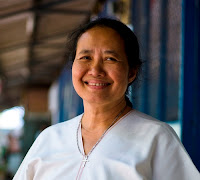
Dr. Cynthia Maung
 Dr. Cynthia Maung fled Burma/Myanmar in 1989 when militants entered her town and burned her entire village.  With a small group of students, Dr. Cynthia opened a makeshift medical clinic in a rickety wooden house on the dusty outskirts of Mae Sot, Thailand.  All of the clinic’s medical instruments fit into the woven bag Dr. Cynthia had slung over her shoulder during their ten-night trek through the jungles of Burma’s eastern border region. With these limited tools and a commitment to care for all who fled conflict and poverty, the Mae Tao Clinic was born.

“We didn’t expect to be here 20 years,” Dr. Cynthia says. But unstable conditions prevented returning to their homeland, so the group continued to work at the humble clinic using limited resources, medicine, education and outreach to relieve human suffering and heal broken communities.
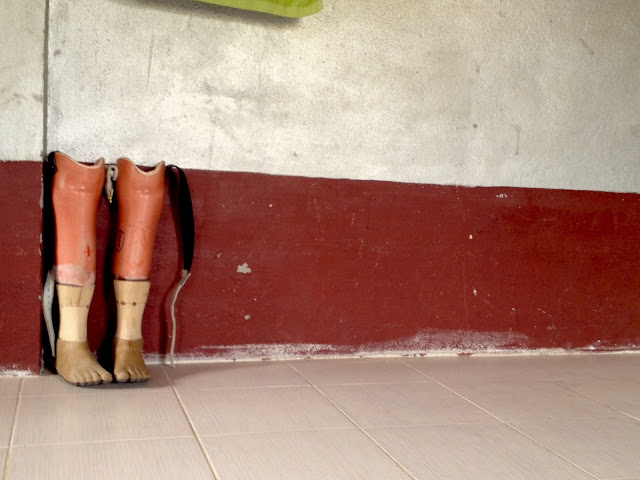
Prosthetic legs awaiting a land mine victim
Two decades later, the Mae Tao Clinic (MTC) has grown into a comprehensive community health center and a hub for regional health training with more than 1,000 graduates serving clinics, schools, villages, factories, camps and slums along both sides of the Thai-Burma border.
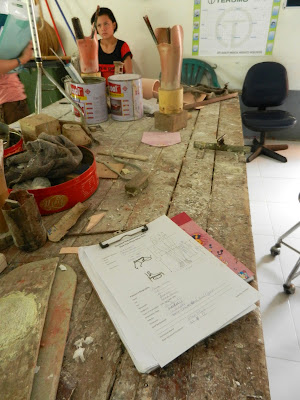
Prosthetic Design and Fitting Table
Mae Tao Clinic serves a target population of approximately 150,000 and shoulders an annual caseload of about 90,000 patients. The staff sees between 300-400 patients per day; runs a jungle field clinic; and feeds 2,000 school children, patients, staff and their families every day. About half of the clinic’s patients are from the local Burmese migrant community, with the rest traveling from inside Burma to seek health care.

Mae Tao Clinic treats everything from minor maladies to malaria, tuberculosis (TB), HIV/AIDS, malnutrition, pneumonia, acute diarrheal diseases, diabetes, epilepsy, thyroid disease, cancer and mental illness. The clinic’s medics are trained in surgery, reproductive health (including labor and delivery), eye health, dental health, prosthetics, pediatrics, lab services, and social work. 

Just last year alone, they had 280 prosthetic projects, with most of them needed due to land mine explosions and gunshot wounds that occurred on the other side of the border.  Each day, the clinic delivers on average 10 babies. 


MTC has set up safe houses for abused women and abandoned children; counseling and home-based treatment for HIV/AIDS patients; a mobile medic program to train and equip health workers in areas of Burma that have no medical care; an education and advocacy program — including 72 migrant school — to protect thousands of children (many without parents) from malnutrition, child trafficking and labor exploitation. The clinic also provides emergency food, shelter and medical care in the wake of environmental and political crises.
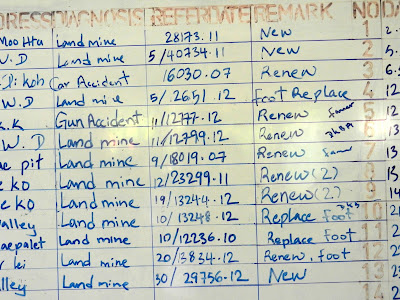
Prosthetics Project Board - which lists the reasons for each project
For me personally, the “coolest” (read: most unique, daring, dangerous and needed) aspect of the Clinic, were the Backpack Doctors.  The Backpack Doctors are a small team of about 2-3 doctors, who travel within Burma/Myanmar bringing medical services, vaccinations and assistance to those who are trapped within the borders and remote areas.  They are the most needed aid in that NGOs, governments, and aid workers cannot access this group of people.  There are 95 different backpack “territories” that each have their own backpacker team which aims to serve 2,000 internally displaced persons.  These teams are the only source of medical care for these populations.  These Backpack Doctors risk their lives each and every day to bring health care to these isolated communities, and in the few years that they have been operating, seven doctors have been killed due to landmines and gunshot wounds, with another two arrested by the government just last year.

A glimpse into Ashley’s Field Notes


If I had been a good note-keeper, I would have documented every bead of sweat that slowly ran down my face and fell on paper as we scrambled to capture the components of the camp.  Truth be told, it was 114 degrees that day, and we were all so excited to run around, I didn’t even notice how hot it was until we got back to our hotel and I saw my dirt stained clothes, sweat-covered hair and beat red skin.  And it was all worth it.  Below please find a few other snippets from my notes from the field…

Education Across the Border:  Because of the aid, resources, and opportunities that are available in Mae La Camp, many parents send their children to the camps specifically for an education.  Children are smuggled into Thai borders by car, boat, and over the mountain pass in order to obtain the camp’s precious education.  Many of these children are sent without their families and there are NGOs within the camp that provide shelter, food, clothing and support for these orphans.  We visited one orphanage alone that housed 79 children!  The education facilities in the camp have a 99% retention rate and education is taken very seriously.

Outside one of the orphanages in Mae La
Second and Third Generation “Campers:”  Because of the amount of time that some families have been in the camps, there are second and even third generation “campers” – meaning that there are third generation children who has been born in and lived their entire lives in the camps.

Our Pursuit of Justice research team and our brilliant interpreter
Technicalities of the Term:  Because Thailand has not ratified the Convention on the Rights of Refugees, although the individuals within these locations are designated “refugees” by the United Nations High Commissioner for Refugees (UNHCR), they are not recognized as such and technically cannot be called “refugees.”  Similarly, the area itself cannot be labeled as a “Refugee Camp” because they are not recognized as refugees, hence Thailand’s usage of the term “temporary shelter.”  Despite the fact that the camps have been in use now for nearly 30 years, Thailand refuses to recognize them or rename them as anything else.

The Rise of a New Dawn:  We went to visit Yaung Chi Oo Workers Association (YCOWA), a Burmese NGO that works in Mae Sot to protect the rights of migrant workers in Thailand.  Although wages in Thailand are not high, and employees face serious exploitation (not to mention arrest if caught illegally within Thailand’s borders), the wages and conditions far surpass the opportunities in Myanmar, hence the overwhelming population of 250,000 migrant workers in Mae Sot alone.  The workers here in Mae Sot earn 50-60 baht per day (less than $2 USD) and work minimum 12 hours with no holidays or breaks.  75% of the migrant workers are women and YCOWA notes that it is more difficult to engage women in vocalizing their rights than men.  Despite these difficulties, the organization has had several triumphs against big corporations and continues to champion for better conditions.  Yaung Chi Oo roughly translates to mean “a new sun” or “the rise of a new dawn.” 

Second Glance: Domestic Violence by any other Name

"Temporary Shelters" in Mae La
  Yet, of course, there is always reason for a follow up glance – which revealed startling practices.  Domestic violence was an incredibly touchy subject, but one that was of serious importance to our research team of four young women from Thailand, Taiwan, Indonesia and the United States.  We came from seriously different backgrounds in how our governments dealt with the issue, and we were curious to see how domestic violence was handled in the camp.

Perhaps most interestingly, was the fact that when we first asked, it was clear our translator did not understand the term “domestic violence.”  I assumed it was just a translation error, and we explained through gestures and further explanation to which our translator, once he understood, responded with a nervous laugh.  It was only until later in the day after conducting more research at a Karen Women’s Organization who provides shelter for women fleeing their husbands, did it occur to us that the term “domestic violence” had no equivalent in the Karen language and no one knew of the term.
Food rations awaiting distribution at the camp

Later in the conversation – we learned a new definition for the term “rape.”  In the camp, “rape” referred to an unmarried girl under the age of 18 who was forced to have sex with a man.  My heart sank as I heard this, and before my classmate even finished asking her questions, I anticipated another blow.  Narisara asked, “Well what does that mean if there is an unmarried woman who is forced to have sex but she is over 18, or a wife who is forced to have sex with her husband without consent?”  The response, which goes without need to elaborate, was gut-wrenching.

At first, the judge answered that when there are disagreements between male neighbors, mainly because one is drunk, they bring that man into the detention center for 24 hours until the alcohol wears off.  When we continued to pry into the issue of violence within the home and within the family as we were more interested in the pursuit of justice for women, the judge shifted uncomfortably in his chair.  He gave a one-line answer about how these issues were typically dealt within the family.  But this wasn’t an acceptable answer for us – and he should have known that four educated women would pounce at his shady response.  All four of us at the same time opened our mouths to further question, and it became quickly clear to us that this issue had personal interest for our entire group.
Outside the Camp Justice Center
As we continued to ask guiding questions such as “how would I go about reporting that my husband hits me?” or, “what happens to someone when they hurt someone else” the truth came out, and as the judge responded honestly to our questions and prompts, the hurt of the answer was worn on each of our faces…
In response to our question about how a woman would go about reporting a crime, she is to report directly to the Zone leader – the male that is in charge of the section of the camp.  He must then decide if the case is worth pursuing, and if an investigation is to take place.  If a woman is raped, before she can report the crime, she must first seek treatment from the hospital to confirm that a rape has taken place.

Collecting plastic near the road in Mae La
As if that weren’t enough, we continued to pry into the criminal procedures for punishment of domestic violence.  After a domestic violence crime is reported and investigated (and as the judge notes, it is often by concerned neighbors and not the wife herself) the wife is brought before the court and her husband, and is asked to forgive him.  He then takes an oath, saying that he will not hurt her again.  Of course – stunned, I blurted out, “But what if he does it AGAIN?!”  The translator tried to answer himself saying, “well that doesn’t really happen all that often around here…” but the judge said he would answer and without translation, knew what we were asking.  He said, if it happens again, the husband is jailed for 24 hours and again the wife is brought before her husband and the court to forgive him.  The same oath is taken, and they go home.  Should the issue continue, they will alert higher authorities of the Karen Refugee Committee and often UNHCR is brought in to “resettle” the woman faster.  Reading between the lines, this means that should a woman continue to report domestic violence, she will be removed from the camp and sent away from her family, her friends, her community, her religion, her language, etc. and sent to a foreign place.  What person in their right mind would want that?!

The judge of the Elders
Coming in with social preconditions, it was very difficult to hear some of these issues that women in the camp face today.  Although I scolded myself for being so judgmental in the beginning about the differences in the legal systems (“What do you mean you don’t write the law down?!”), by the end, I was simply silent, internally reflective, and incredibly grateful for the avenues of justice that are available to me as a woman.  Although they are not perfect, I have words to describe what happens when a woman, regardless of age, is forced to have sex without consent and I have remedies to seek for the wrongdoings against acts of violence against women.  

I looked at the judge.  I looked directly into his eyes, confused, upset, angry, and looked for answers.  His face was incredibly wrinkled with age and as he spoke, I watched his beetle-nut stained lips answer our questions.  I respected him for his honest answers, and for taking the time to answer each question with care.  And as I looked up into his eyes, I could see our pain stricken faces and closed gestures were taken to heart by this man. 

Balancing the Scales of Justice in Mae La

We had pre-determined our research groups before we left.  The other two groups had serious focus on their theses – with some looking at displaced persons and why they decided to cross borders and others looking at the health and education systems.  I realized in the formation of the groups that I was the only one who was not writing my thesis on migration issues, and felt a little out of place…until I found my group.  They were all working on migration issues – but they were migration issues in other countries and this field research was ample practice for their theses, but in no way would this information benefit their work directly.  

I have always been a sucker for justice and was desperate to learn more about the justice system in the camps – and whether the camp is successful in keeping order over nearly 50,000 people.  A few of the other girls were interested in the religious components as well – so we morphed together our topics and decided to analyze the role of religion and women in the Mae La justice system.  I can tell you – the research we found was fascinating and unlike any other justice system I have seen in the world.

As we walked along one of the main roads in the camp towards the Justice Center, I tried to take in my surroundings.  Huge bamboo houses with porches, gardens and balconies stared back at me.  Banana leaf roofs rustled with the breeze, and the sun reflected painfully off of the sparkling clean dirt roads.  As we tried to take the back roads to see what wasn’t on the main path, we were faced with more large houses, bamboo frames perfectly aligned and banana leaves.  People walked by staring at our group of four women with notebooks, and we stared right back, admiring their perfectly ironed longyi and white pressed shirts.  Covered in sweat and dirt, and sunburned after standing in the sweltering sun for a measly ten minutes, we managed to muster our way towards the Justice Center. 

First, we went to meet with a member of the Elder Council – one of the main judges in the camp.  As we asked questions (and I had to sit on my hand to prevent myself from asking TOO many questions) I realized everything I had studied about Western democratic law – did not apply here.  For starters:

  1. They do not have codified (written) law.  There is nothing that warns or reminds the people of the law – it is customary, and said to be “understood.”
  2. Religion plays a significant role in law – even though the camp is not entirely Christian, the customary law of the camp is Karen law, meaning that Muslims and Buddhists must adhere to the same laws as Karen Christians.
  3. Precedent is not a concept utilized here.  Each case is dealt with on an independent basis, with no reference to previous cases to determine appropriate penalties for crimes committed, comparing sentencing of previous cases, etc.
  4. Judges do not have any training or experience, other than that they are “elders” and old – having witnessed several generations.  I asked if there was a balance in gender, ethnicity, or religious backgrounds and the judge said “it depends on who is elected.”  So I then proceeded to ask if there had been any women, non-Karen, or non-Christian judges…“no."
Poster Board displaying families who have been resettled to U.S.
Affairs were punishable with seven months in prison, and Karen law appropriately sentences individuals who place magic spells on others (such as a spell to kill or trick someone).  

At first glance, I was incredibly impressed.  I was amazed that the Thai people had entirely handed the justice and legal matters of the camp over to the local Burmese/Myanmar people.  The justice system, unless it needed to go to a higher level (which was at the camp level and only for the most serious crimes), was entirely run by its people – making decisions on sentencing, presiding over rulings, and guarding prisoners in the detention center.

Mae La Refugee Camp/Temporary Shelter, 25-27 April 2012


Mae La Temporary Shelter, Mae Sot, Tak Province, Thailand
To say I was excited about this trip sounds perhaps inappropriate given the nature of the visit.  Going to conduct field research in Thailand’s largest “temporary shelter” – a shelter that has been around since 1984 – seemed daunting given that there are approximately 49,000 displaced persons in the camp.  Nevertheless, the entire week prior to the trip, and the entire six hour bus ride up to Mae Sot on the border between Thailand and Myanmar – I was itching with excitement at the chance to walk around my first “refugee camp.”

I prepared myself for a difficult and emotional visit.  I expected to see hardships, trash littered dirt alleyways, bad water, smelly waste areas and those little brown innocent wide eyes that stare up at you.  When our military escort into the camp pulled up to park, I anxiously jumped out of the car.  We were told we could not take pictures and each of us had carefully listened to directions by shoving our cameras in our clothes hidden from plain sight.  

Our first stop was the Managerial Unit – where we were taken inside a room and given a debriefing of the area.  I tried to sneak around and “go to the bathroom” and investigate the things outside the arranged meeting room, but didn’t find anything.  I listened as the camp officers outlining the composition of the camp:

  • 26,822 people living in the camps, 4,583 families, are displaced directly due to conflict in Myanmar.
  • Since January 2006, a total of 31, 503 displaced individuals have been resettled in third countries, with the majority (28,482 people) being sent to the United States. 
  • On average, 70-80 babies are born each month in the camp
Although the camp had not taken new arrivals since 2007, there are individuals who return illegally – sneaking into the camp.  This creates a problem for both the camp officials and the families, as food is rationed based only on those who are registered, and as a result, should more family members sneak in unregistered – the food rations must be split unevenly between some families.  Furthermore, religion was an issue, with nearly 50% of the camp practicing Christians, 35% Buddhist and another 15% practicing Islam.  This division through religion was largely noticeable with the camp’s 59 churches, 4 temples and 5 mosques.

And with that brief introduction, we split up into our research groups, met our translators, and set out into the unknown…Mae La camp.