If I had been a good note-keeper, I would have
documented every bead of sweat that slowly ran down my face and fell on paper
as we scrambled to capture the components of the camp. Truth be told, it was 114 degrees that day,
and we were all so excited to run around, I didn’t even notice how hot it was
until we got back to our hotel and I saw my dirt stained clothes, sweat-covered
hair and beat red skin. And it was all
worth it. Below please find a few other snippets
from my notes from the field…
Education
Across the Border: Because
of the aid, resources, and opportunities that are available in Mae La Camp,
many parents send their children to the camps specifically for an
education. Children are smuggled into
Thai borders by car, boat, and over the mountain pass in order to obtain the
camp’s precious education. Many of these
children are sent without their families and there are NGOs within the camp
that provide shelter, food, clothing and support for these orphans. We visited one orphanage alone that housed 79
children! The education facilities in
the camp have a 99% retention rate and education is taken very seriously.
 |
| Outside one of the orphanages in Mae La |
Second
and Third Generation “Campers:” Because of the amount of time that some
families have been in the camps, there are second and even third
generation “campers” – meaning that there are third generation children who has
been born in and lived their entire lives in the camps.
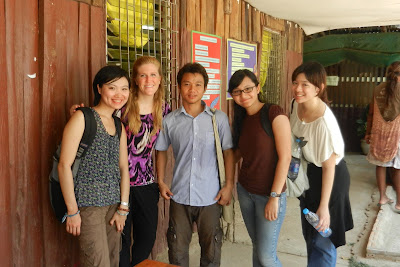 |
| Our Pursuit of Justice research team and our brilliant interpreter |
Technicalities
of the Term:
Because Thailand has not ratified the Convention on the Rights of
Refugees, although the individuals within these locations are designated “refugees”
by the United Nations High Commissioner for Refugees (UNHCR), they are not
recognized as such and technically cannot be called “refugees.” Similarly, the area itself cannot be labeled
as a “Refugee Camp” because they are not recognized as refugees, hence Thailand’s
usage of the term “temporary shelter.”
Despite the fact that the camps have been in use now for nearly 30
years, Thailand refuses to recognize them or rename them as anything else.
The
Rise of a New Dawn:
We went to visit Yaung Chi Oo Workers Association (YCOWA), a Burmese NGO
that works in Mae Sot to protect the rights of migrant workers in
Thailand. Although wages in Thailand are
not high, and employees face serious exploitation (not to mention arrest if
caught illegally within Thailand’s borders), the wages and conditions far
surpass the opportunities in Myanmar, hence the overwhelming population of 250,000
migrant workers in Mae Sot alone. The
workers here in Mae Sot earn 50-60 baht per day (less than $2 USD) and work
minimum 12 hours with no holidays or breaks.
75% of the migrant workers are women and YCOWA notes that it is more
difficult to engage women in vocalizing their rights than men. Despite these difficulties, the organization has
had several triumphs against big corporations and continues to champion for
better conditions. Yaung Chi Oo roughly
translates to mean “a new sun” or “the rise of a new dawn.”


No comments:
Post a Comment