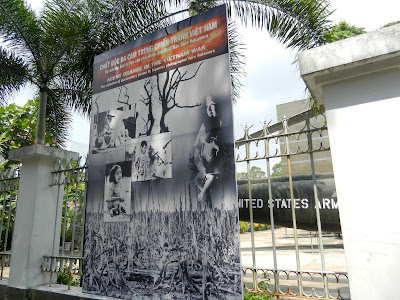
 |
| War Remnants Museum, Ho Chi Minh City, Viet Nam |
Please note this entry contains graphic photos.
I always wondered how Germans, 50
years after World War II, could still
feel guilty for the Holocaust – when they had nothing to do with the war, weren’t
even alive at the time to witness it, and times have long changed. But now, today, I get it. Completely.
I feel embarrassed, angry, outraged, responsible but most of all –
heartbroken at the actions taken by my country in the Vietnam War.
 |
| Body of killed soldier evacuated by helicopter |
Americans always pride themselves in
being the forerunners for democracy, human rights and the American Dream – and today,
I witnessed how our ‘great nation’ single-handedly destroyed another. The
amount of damage that was inflicted by the United States military during the
twenty years it fought in Vietnam cannot be encapsulated in one museum,
however, from the tour of the War Remnants Museum in Ho Chi Minh City, a small
glimpse on this insight can be unleashed.
I started off incredibly excited to
see a part of history presented from a different perspective. I was well aware that my education, although
very critical, had not always been prevented from a non-bias angle, and I was
anxious to hear the other side. We had signed up for a full day of activities
in the city – a small minibus that would drive us around from site to site,
describing the history of each structure, museum, palace and building. The War Remnants Museum was our first
stop. As we pulled up to the door, our
tour guide, Win, said “This is the war Americans never talk about and certainly
the war that they try to cover up.” She
couldn’t have been more right. And that two
hour visit to the museum couldn’t have been more difficult.
 |
| American soldiers torturing captured enemy by pouring water over towel to suffocate |
For
those of you who need a refresher (as I did!) the Vietnam War (known here in Vietnam as the ‘American War’)
was a Cold War-era conflict that occurred in Vietnam from 1 November 1955 to
the fall of Saigon on 30 April 1975. The battle over communism was fought
between North Vietnam, supported by its communist allies, and the government of
South Vietnam, supported by the United States of America and other anti-communist
countries. The Viet Cong (also known as
the National Liberation Front, or NLF), a lightly armed South Vietnamese
communist-controlled common front, largely fought a guerrilla war against
anti-communist forces in the region. The Vietnam People's Army (North
Vietnamese Army) engaged in a more conventional war, at times committing large
units into battle. U.S. and South
Vietnamese forces relied on air superiority and overwhelming firepower to
conduct search and destroy operations, involving ground forces, artillery, and airstrikes.
 |
| Vietnamese women and children hiding from American troops |
The
U.S. government viewed involvement in the war as a way to prevent a communist
takeover of South Vietnam as part of their wider strategy of containment. American military advisors arrived in the
country beginning in 1950 but the first U.S. combat units weren’t deployed
until the beginning of 1965. American
involvement in the war peaked in 1968, at the time of the Tet Offensive, and
ended on 15 August 1973. The capture of
Saigon by the Vietnam People's Army in April 1975 marked the end of the war,
and North and South Vietnam were reunified the following year.
As I wandered past pictures of fallen international
journalists and American soldiers, I stopped to read each story about the life
of each American soldier, their hometown, training, and sadly enough – their young
age. But once I left this exhibit and
entered the main portion of the museum, it was clear that these were not the
only victims and soon, voices of victims I had never heard before became loud
and clear.
 |
| Mai Lai massacre |
If
you look at the war itself – it is clear that the Americans lost. But if you look at the deaths and long term
damage, there is no denying that the Vietnamese suffered to a far greater
extent. 58,220 Americans were killed at
an average age of 23.11 years, with 11,465 killed under 20 years of age. However, this does not even come close to
grasping the amount of deaths for Vietnam – a loss of nearly 10% of their
population, with over 3 million lives lost.
Of course it is unfair to compare the value of lives lost against one
another, as any death in this way is tragic and unnecessary, but the damage
done to Vietnam extends much farther than death toll numbers.
 |
| Terrified family seen through the legs of a US soldier |
Numbers alone cannot speak for the
victims. The amount of horrific abuses
including violent rapes to women and children in rural villages is not recorded
or even mentioned to Americans. The
massacre at Mai Lai, where the United States military murdered 504 unarmed civilians
from ages one to 82, mainly comprising of women and children was something I
had heard in passing, but what was gut-wrenching was learning about the dozens
of other massacres that the US military executed that did not catch the
international mainstream eye. It took
the United States and international community 20 months to uncover Mai Lai –
and there are dozens of others that to this day remain unreported and unknown.
Perhaps, although taken entirely out
of context, President Richard M. Nixon said it best, in his 1969 speech, “Let
us understand: North Vietnam cannot defeat or humiliate the United States. Only
Americans can do that.”
As a country who prides itself as the leader of democracy,
freedom, and liberty, what we executed in the Vietnam war was humiliating – and
we can only blame ourselves for it.
*I would just like to note that my overwhelming emotions from
today are not directed primarily at Vietnam War veterans, their credibility, or
their families. I feel that the actions
taken by the United States government were inexcusable and incriminating and my
shock is in relation to the lack of accountability that the United States, or
any government of the world, has raised against the U.S. for these horrific
actions.
 |
| American soldier rescuing Vietnamese baby from the battlefield |


No comments:
Post a Comment